
A 'Cookbook' for Digital Twins: Future Insight wins Geonovum NLDT Testbed 2
Geonovum has given the official go-ahead for the second phase of the national testbed (NLDT Testbed 2), and Future Insight has been selected again! While in the first phase we demonstrated how architectural 3D models (BIM) and geographic data (GEO) speak the same language, we are now focusing on the simple reuse of complex work processes.
What is the Geonovum NLDT Testbed 2?
Geonovum develops and manages open geo-standards in the Netherlands and works on the national geo-information infrastructure commissioned by, among others, the Ministry of the Interior and Kingdom Relations. With the nLDT Testbed 2 ('Digital Twin as a Service'), they stimulate (the development of) a robust, nationwide network of interoperable Digital Twins.
The goal? To no longer lock complex calculation and simulation models (such as heat stress, flooding, or traffic) into complicated software, but to make them easily accessible and connectable for everyone via open standards such as OGC API - Processes and DCAT application profiles.
What is Future Insight developing?
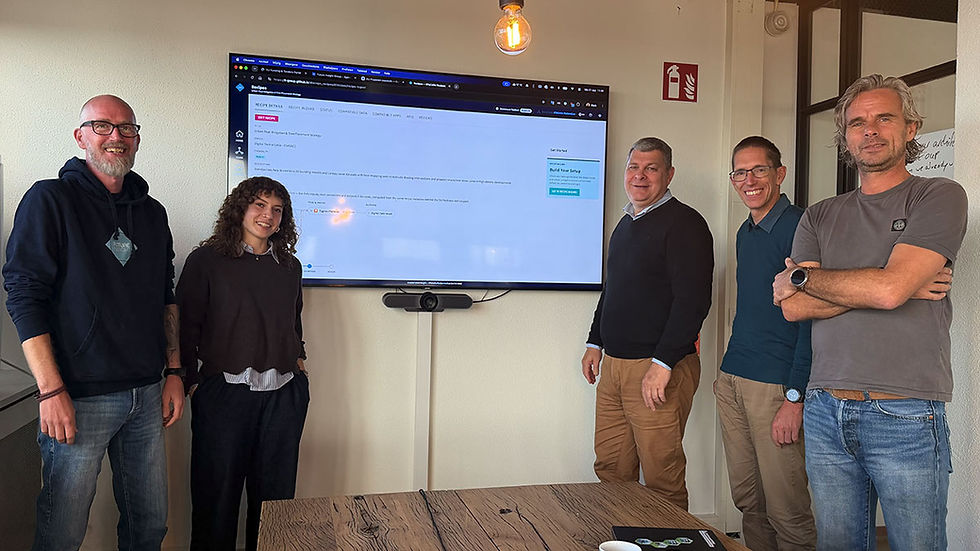
Within research theme #4 (App Store / Recipes), our team, led by Margriet Visscher, Simay Batum, and Ed de Later, is developing an open prototype to solve societal challenges according to the 'recipe principle':
An intuitive App Store (also known as a Marketplace): One central, browser-based place where you can easily find available data sources, simulations, and tools.
The recipe book : A collection of standardized recipes that guide you step-by-step in setting up simulations. Once a calculation model has been set up as a recipe, anyone inside or outside the organization can perform the exact same calculation over and over again with the same reliable result.
The 'Cook' (The automatic chef) : The smart background service that reads the recipe and automatically links data. For example, it takes the outcome of Step 1 (a calculation of rainwater flows) and passes it directly on as input for Step 2 (a model that calculates risks for buildings).
Why is this important for the living environment?
Combining 3D maps, soil data, and computational models currently requires significant time and specific IT knowledge. By decoupling work processes from specific software packages and anchoring them in open standards, we prevent classic vendor lock-in. With our Clearly.Hub platform as an inspiration, we demonstrate how governments and experts can make faster and smarter decisions for the physical environment.
When do we deliver?
Work in our test environment is in full swing. We share all developed source code open source via GitHub (under a CC BY license) with the geo-community.
Autumn 2026 : Delivery of the working prototype and a complete demonstration video.
November 2026 : Live demonstration of our prototype on the international stage during the Barcelona Smart City Expo!
With this approach, we make reusing complex simulations for our cities and villages just as easy as following a cooking recipe.
Would you like more information about the Clearly.Hub ? We would be happy to show you how the Clearly.Hub works for you. Contact Bas Hoorn for a no-obligation consultation and demonstration. Bas Hoorn: | ✉️ [email protected] | 📞 +31 (0)6 - 46 90 97 84


